How Was Greek Art Made What Was Greek Art Made Out of
Greek art began in the Cycladic and Minoan culture, and gave nascency to Western classical art in the subsequent Geometric, Archaic and Classical periods (with further developments during the Hellenistic Period). It absorbed influences of Eastern civilizations, of Roman fine art and its patrons, and the new religion of Orthodox Christianity in the Byzantine era and absorbed Italian and European ideas during the menstruation of Romanticism (with the invigoration of the Greek Revolution), until the Modernist and Postmodernist. Greek art is mainly five forms: architecture, sculpture, painting, pottery and jewelry making.
Aboriginal period [edit]
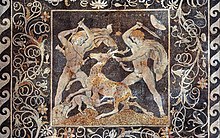
Creative production in Greece began in the prehistoric pre-Greek Cycladic and the Minoan civilizations, both of which were influenced by local traditions and the art of ancient Arab republic of egypt.
At that place are iii scholarly divisions of the stages of later ancient Greek fine art that correspond roughly with historical periods of the aforementioned names. These are the Archaic, the Classical and the Hellenistic. The Primitive period is unremarkably dated from 1000 BC. The Persian Wars of 480 BC to 448 BC are usually taken as the dividing line between the Archaic and the Classical periods, and the death of Alexander the Keen in 323 BC is regarded as the event separating the Classical from the Hellenistic flow. Of course, different forms of art developed at different speeds in different parts of the Greek earth, and varied to a degree from artist to artist.[1] There was a sharp transition from one menses to some other.
The art of ancient Greece has exercised an enormous influence on the culture of many countries from ancient times until the present, particularly in the areas of sculpture and architecture. In the W, the art of the Roman Empire was largely derived from Greek models. In the E, Alexander the Bang-up's conquests initiated several centuries of exchange between Greek, Central Asian and Indian cultures, resulting in Greco-Buddhist art, with ramifications as far as Japan. Following the Renaissance in Europe, the humanist aesthetic and the high technical standards of Greek art inspired generations of European artists. Pottery was either blue with blackness designs or black with blue designs.
Byzantine period [edit]

Byzantine art is the term created for the Eastern Roman Empire from nigh the 5th century until the fall of Constantinople in 1453. (The Roman Empire during this period is conventionally known as the Byzantine Empire.) The term tin also be used for the art of states which were contemporary with the Byzantine Empire and shared a common culture with it, without actually beingness part of it, such as Republic of bulgaria, or Russia, and also Venice, which had shut ties to the Byzantine Empire despite beingness in other respects function of western European culture. Information technology tin can also be used for the art of people of the erstwhile Byzantine Empire under the rule of Ottoman Empire after 1453. In some respects, the Byzantine artistic tradition has connected in Russia and other Eastern Orthodox countries to the nowadays twenty-four hour period.[2]
Byzantine art grew from the art of ancient Greece and, at to the lowest degree before 1453, never lost sight of its classical heritage, just was distinguished from information technology in a number of ways. The most profound of these was that the humanist ethic of ancient Greek fine art was replaced past the Christian ethic. If the purpose of classical fine art was the glorification of human, the purpose of Byzantine fine art was the glorification of God.
In place of the nude, the figures of God the Begetter, Jesus Christ, the Virgin Mary and the saints and martyrs of Christian tradition were elevated and became the ascendant - indeed almost exclusive - focus of Byzantine art. One of the nigh important forms of Byzantine art was, and still is, the Cretan school as the leading school of Greek post-Byzantine painting later on Crete fell to the Ottomans in 1669. Like the Cretan school, it combined Byzantine traditions with an increasing Western European creative influence, and as well saw the start signiand the National Gallery of Art in Washington, D.C.[three]
Post-Byzantine and mod flow [edit]


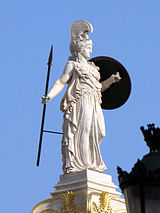
Cretan School describes the school of icon painting, likewise known as Post-Byzantine fine art, which flourished while Crete was under Venetian dominion during the late Center Ages, reaching its climax later the Fall of Constantinople, becoming the central forcefulness in Greek painting during the 15th, 16th and 17th centuries. The Cretan artists developed a detail style of painting under the influence of both Eastern and Western creative traditions and movements; the nearly famous product of the school, El Greco, was the most successful of the many artists who tried to build a career in Western Europe, and also the i who left the Byzantine fashion farthest backside him in his later career.
The Heptanese School of painting (Greek: Επτανησιακή Σχολή, lit.'The School of the seven islands', also known as the Ionian Islands' School) succeeded the Cretan School equally the leading schoolhouse of Greek post-Byzantine painting after Crete cruel to the Ottomans in 1669. Like the Cretan school it combined Byzantine traditions with an increasing Western European artistic influence, and also saw the start significant depiction of secular subjects. The school was based in the Ionian Islands, which were not part of Ottoman Hellenic republic, from the middle of the 17th century until the middle of the 19th century.[4]
Mod Greek art, afterward the establishment of the Greek Kingdom, began to be adult effectually the fourth dimension of Romanticism. Greek artists absorbed many elements from their European colleagues, resulting in the culmination of the distinctive style of Greek Romantic fine art, inspired past revolutionary ideals equally well as the state's geography and history. Later centuries of Ottoman dominion, few opportunities for an education in the arts existed in the newly independent Hellenic republic, so studying away was imperative for artists. Munich, as an important international center for the arts at that time, was the place where the majority of the Greek artists of the 19th century chose to study. Later on, they would render to Hellenic republic and pass on their cognition. Both academic and personal bonds developed between early Greek painters and Munich artistry giving nativity to the Greek "Munich School" (Greek academic art of the 19th century). Nikolaos Gysis was an important teacher and artist at the Munich Academy and he presently became a leading figure amidst Greek artists. Many of these Munich School artists chose subjects such as everyday Greek life, local community, and living weather. Several important painters emerged at this time. Theodoros Vryzakis specialized in historical painting and peculiarly inspired by the 1821 Greek War of Independence. Nikiphoros Lytras full-bodied on realistic depictions of Greek life. Georgios Jakobides devoted his attention to infants and children and he would laterbecome the kickoff Managing director of the new National Gallery of Athens. Georgios Roilos was another leading painter of the menstruum closely associated with the Munich Schoolhouse, particularly in his early on career. Konstantinos Volanakis was inspired mostly past the Greek sea.[5]
Other notable painters of the era are Theodore Ralli, Ioannis Altamouras and the folk painter Theofilos Hatzimichail. Notable sculptors of the era are Leonidas Drosis (his major work was the all-encompassing neo-classical architectural ornament at the Academy of Athens, Lazaros Sochos, Georgios Vitalis, Dimitrios Filippotis, Ioannis Kossos, Yannoulis Chalepas, Georgios Bonanos and Lazaros Fytalis.
Major museums and galleries in Greece [edit]
Attica [edit]
- Acropolis Museum
- National Archaeological Museum, Athens
- National Gallery (Athens)
- Byzantine and Christian Museum
- National Museum of Gimmicky Art, Athens
- Benaki Museum
- Goulandris Museum of Cycladic Art
- Stoa of Attalos
- Numismatic Museum of Athens
- Archaeological Museum of Piraeus
Thessaloniki [edit]
- Archaeological Museum of Thessaloniki
- Museum of Byzantine Culture
Crete [edit]
- Heraklion Archaeological Museum
- Archaeological Museum of Chania
- Agia Triada Monastery
Corfu [edit]
- Archaeological Museum of Corfu
- Byzantine Museum of Antivouniotissa
Rest of Greece [edit]
- Archaeological Museum of Patras
- Archaeological Museum of Volos
- Archaeological Museum of Dion
- Archaeological Museum of Amphipolis
- Archaeological Museum of Pella
- Archaeological Museum of Veroia
- Archaeological Museum of Thasos
- Archaeological Museum of Delos
- Archaeological Museum of Rhodes
- Archaeological Museum of Epidaurus
- Archaeological Museum of Olympia
- Delphi Archaeological Museum
- Nea Moni of Chios
- Florina Museum of Mod Art
See also [edit]
- History of Hellenic republic
- Civilisation of Hellenic republic
- Modern Greek art
- Byzantine and Christian Museum
References [edit]
- ^ Henri Stierlin. Greece: From Mycenae to the Parthenon. Taschen, 2004.
- ^ C. Mango, ed., The art of the Byzantine Empire, 312-1453: sources and documents (Inglewood Cliffs, 1972)
- ^ "Theodoros Stamos". Toomey-tourell.com. 2021-03-08. Retrieved 2021-03-19 .
- ^ "archive.gr - Διαδρομές στην Νεοελληνική Τέχνη". Archived from the original on September 27, 2007.
- ^ "Archived copy" (PDF). Archived from the original (PDF) on 2011-06-06. Retrieved 2007-02-06 .
{{cite web}}: CS1 maint: archived re-create as title (link)
External links [edit]
- Aboriginal Hellenic republic website
- Art History Resource on the Web: Greek Fine art
- A History of Greek Fine art by Frank Bigelow Tarbell
- A History Of Greek Art by F. B. Tarbell
- Byzantine Fine art Charles Diehl
- National Gallery of Athens
- Modern Greek Painters
Source: https://en.wikipedia.org/wiki/Greek_art
0 Response to "How Was Greek Art Made What Was Greek Art Made Out of"
Post a Comment